The first thing we wanted to do, when we arrived on the South Island of New Zealand, was to hike or kayak in Abel Tasman National Park. In fact, we did both. But we’re getting ahead of ourselves.
Showing posts with label Trekking. Show all posts
Wednesday, February 13, 2013
Tuesday, November 27, 2012
Machu Picchu video
We forgot to include this video--a panoramic view of Machu Picchu on our second day there:
Labels:
Inca Trail,
Machu Picchu,
Peru,
RTW,
Trekking
Machu Picchu
We got up at 3:20, had a fast breakfast, and made our way to the exit checkpoint from the Inca Trail, where we waited about 40 minutes for the officials to arrive.
It was a cloudy morning, but quite pretty. We were all excited to finally see Machu Picchu after our four days of pilgrimage and anticipation. Not to mention that Machu Picchu meant the end of sleeping bags and the resumption of a regular shower schedule. The journey had been challenging, interesting, beautiful and even brutal. But we were ready to see what was at the end of the trail.
The previous night, our last on the trail, our guide mentioned that the correct pronunciation is Machu Peek’chu, not Machu Peachoo. The double ”c” indicates a syllabic stop. It’s very brief, but once he mentioned it, we could hear it when he asked one of our chaskis to pronounce the name. Apparently the Quechua word that’s pronounced ‘peachoo’ is slang for the male genitals, and he said it’s not uncommon to catch the locals chuckling softly at all the tourists talking about “old willy” instead of “old mountain.” If nothing else, it made it easy for us to remember where the double c fell in the two words.
Once we cleared the checkpoint, Lana took off at a brisk pace, and we reached the Sun Gate in about 40 minutes. While we weren’t trying to race anyone in other groups, the excitement of what was on the other side of the hike got the better of us (especially Lana) and anytime someone ahead stopped to take a photo or tie their shoe, we moved past them and hurried on. Once we arrived at the sun gate we were disappointed to find that we were completely in the clouds. We could barely see our shoes through it, let alone of Machu Picchu. As we walked down the wider path to the guard house, we could see the surrounding mountains towering over us above the cloud layer. Our guide had us take a seat along the wall on the trail, and advised us to be patient—the postcard view would come into focus. We waited there for the clouds to clear, and we could see glimpses of different parts of Machu Picchu. Lana is not the most patient person at the best of times, and she was anxious for the view she felt she’d earned in blood, sweat, and yes, a few tears. David, however, was patient as always, enjoying the beautiful views of the surrounding mountains as they appeared and disappeared in and out of the clouds.
Wait for it…
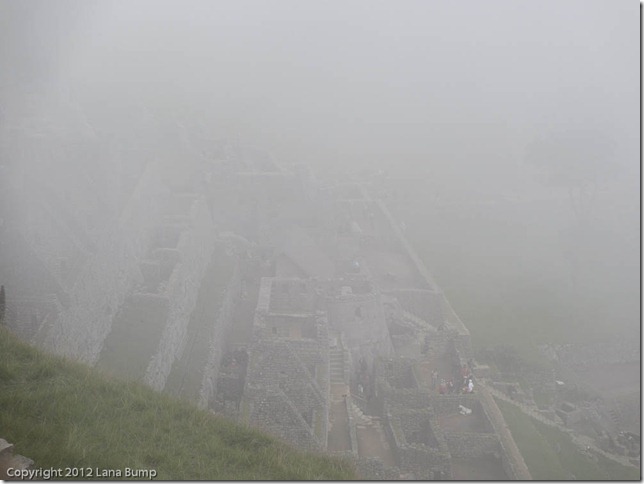
Wait for it…
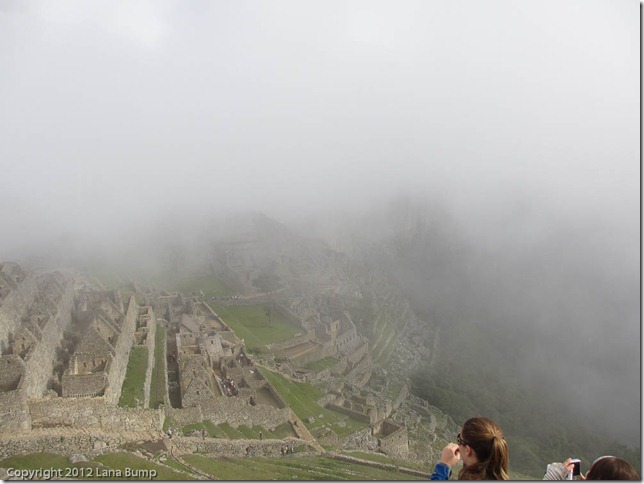
Here it comes…
Any minute now…
Get your camera ready…
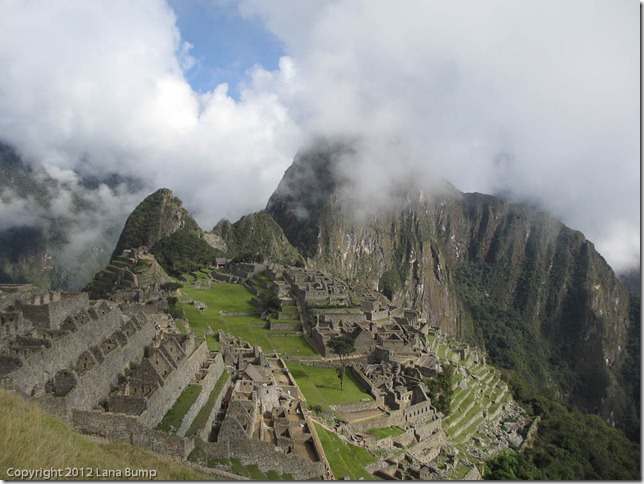
Finally, the clouds parted completely, and we could see our destination. We made it.
Even Mr. Bee made it with us! Of course he was dead weight in Lana’s backpack, but he helped pad her fall so I guess he earned it too.
After we got to Machu Picchu we headed down to the entrance to collect our fellow hikers who had gone back down the mountain after the first day. We had time to store our bags, grab a drink and clean up a little bit in the bathrooms. Then, after reunions and refreshments, we went back into the park for a two hour tour with our guide. This was not our favorite part of the trip, as it felt more like a lecture than a tour, and it seemed as if our guide gave speeches about what he knew. When Lana tried to ask him about something—what looked to be a grinding stone—he sort of shrugged her off. Not quite the same experience we’d had on the trail. After a tour of the general areas, we were free to explore on our own. The group was meeting down in the town, Aguas Calientes, for lunch and eventually everyone else would ride the train back to Ollyantaytambo that night. After four days to get there, it takes less than 2 hours on the train.
We had opted to stay overnight in Aguas Calientes, however, and spend the next day at Machu Picchu and climb the peak behind it, which is known as Huayna Picchu (which means new mountain, or if your pronounce it wrong, “New Willy”). Given the fact that we were tired, stinky, and hot (the sun had come out eventually, and in force), we chose to curtail our visit and headed down the mountain by bus early, around noon. Plus, we knew there was a shower with our names on it down in Aguas Calientes (hot shower in a town called Hot Water, yes). And that had more attraction to us at that moment. Before leaving for the day, we got our passports stamped (the upper stamp is the one we got when we passed the first checkpoint, at the beginning of the Inca Trail). It may be campy, but we felt like we earned those stamps as much as any of the others.
The shower was glorious. I’m pretty sure choirs of angels sang. Using an actual toilet (with a seat! and a lid!) was pretty nice too. We spent the afternoon having lunch with our fellow hikers, mainly just sitting around getting to know each other a bit better and enjoying the camaraderie of a group of people with whom we shared something pretty special. We walked to the train station with them to say goodbye, and also to change our train tickets for the next day, as we planned on coming back earlier than they were. We were able to get them changed to a Vistadome train leaving around 1:30, which meant not only would we see the river valley in the day time, we’d see it in style.
The next morning, we took the bus up to Machu Picchu, which is how most of the 2500 people who can visit in a day arrive; it felt a bit odd after having arrived on foot the day before, but it didn’t feel like cheating. Just very different. We explored the areas we’d skipped previously; it was still early, so there were a lot fewer people, which was great. The site is much larger than either of us expected, from reading about it. The aqueduct system that routes fresh spring water throughout the city still works, and it was neat to see running water popping up in unexpected places. At 10, we started the hike up Huayna Picchu, which is 360 meters or 1200 feet higher than Machu Picchu. Some sections were about as steep as a ladder, with stone steps.
Up was a little tricky, and down was fairly exciting.
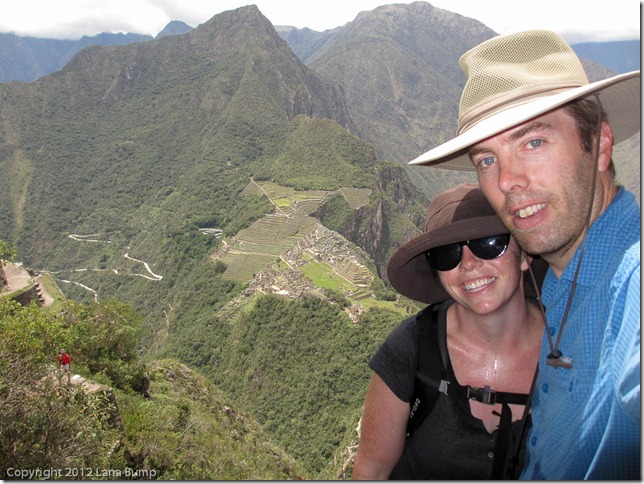
However, the view of Machu Picchu is stunning, and the ruins on Huayna are pretty amazing on their own.
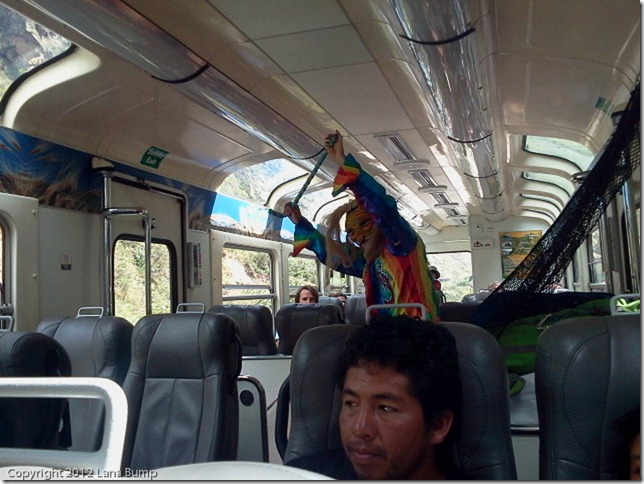
Eventually, we headed back to town, caught our train, and enjoyed a scenic ride through the sacred valley. We also got an unexpected dance and fashion show, as one of the train conductors first changed into a colorful, traditional dancing costume, and cavorted up and down the aisle, and then all three took turns changing into different alpaca wool garments (conveniently for sale), and walked the aisle as if it were a fashion runway. It may have been the oddest thing we saw in Peru, and the bar was not low.
The train ride was beautiful though, and when we got to Ollantaytambo, we were pondering taking a taxi back to Cusco or trying to figure out the next bus when we came upon a couple of guides who had taken the train with us, who were also getting a taxi back to Cusco. They asked us if we wanted to share, and it ended up being a really good deal, about 12 soles each. All told it ended up being a two hour $8 ride through some beautiful landscapes. And we got the inside scoop on the various tour companies in Cusco—their practices, their treatment of the chaskis, and why none of the tour companies are owned by Peruvians—basically for the same reason you can take such an inexpensive taxi ride.
We’d like to say something prosaic here about how the trip changed us, but we’re still thinking about that. We know a little more about ourselves than we did when we started. I think we’ve evaluated our needs and we’re not interested in being that far from a bathroom anytime soon. We know that we can do whatever we have to, and even enjoy it along the way (sometimes). We know that (and this bears capitalizing) We Are Not Campers. This was a pretty special reason to camp, and we decided to do it despite our reservations. Seeing Machu Picchu is a trip of a lifetime, and just the train trip and day or two spent on the mountain are totally worth it. But hiking the trail was a very different experience. There are so many things you see that you would never see otherwise, whether that’s a soccer game played at 3800 meters, or the most delicate orchid hiding in the cloud-forest, or even a train of mules picking their way carefully down a set of stone steps. Hidden lakes, Inca ruins, a plant that makes boys abstinent, trout caught from the stream an hour ago and cooked for your dinner.
If you’re thinking about a trip, or dreaming about it on your “someday” bucket list, we would tell you to go to Machu Picchu. Go however you can, whenever you can. But if you have the time and inclination, you should hike the Inca Trail. If we can do it, then maybe we can inspire you to do it someday too!
Saturday, November 24, 2012
Inca Trail, Peru: Day 2
Day 2 of the Inca Trail is supposed to be the hardest. Over the entire four days, we will climb 1,800 meters (5,900 feet), and descend 2,000 meters (6,500 feet). Today, we will climb 1,100 m (3,600 feet) and descend 600 m (2,000 feet) of that. Prior to arriving in Cusco, we’ve been near sea level for weeks, and we’re concerned that we’ve completely lost any high-altitude acclimation from Colorado. One of the other hikers was throwing up all night, and she is going back to Ollamtaytambo on a horse with our assistant guide, and another hiker who decided turning back now was the wisest course after getting winded on the hill climb out of our campsite. I think it made the rest of us a little more sober about what we were facing.
Fortunately, the day started out cool and cloudy, and we had several hours of pleasant hiking before the sun came out and it got muggy and hot. It still rained on and off, and the chaskis (Quechua for ‘fleet feet’, a name the porters prefer for themselves over the more colonial ‘porter’) had their loads covered with tarps and ponchos. You can’t see it in these pictures but they’re also either wearing rubber sandals or regular tennis shoes. Lana wishes that she’d followed their advice rather than the Peru Treks people’s to rent hiking boots (again, FORESHADOWING).
By the time we reached our next stop, for second breakfast consisting of crackers, ham sandwiches and some damn good popcorn (they seemed to think we needed a lot more food than we thought we did), the rain had retreated up the mountains. This was our last opportunity to buy water, though we will be able to fill our bottles from boiled stream water at each meal, if we want. We’ve been drinking closer to 1 liter a day than the 2.5 recommended, but we feel well hydrated, so we stuck with our comfort level as a guide.
After second breakfast, we were allowed to walk at our own pace (rather than staying roughly together, regrouping every 20-30 minutes for visiting an Inca site, or just to make sure everyone was still ok). Our next meeting point was camp, which is where we’d have lunch and dinner—no more hiking once we reach that, around 2-3 pm. Between us and that is Dead Woman’s Pass (called that because it resembles the profile of a woman on her back, from the other side—although FORESHADOWNG, again), with a saddle at 4,200 m (13,776 feet).
This is where we finally hit our stride. A cool, dry breeze drifted down the valley, and it began to feel more like Leadville than a rain forest. While we were stopping to take pictures and appreciate the scenery (and to breathe), we soon outstripped the rest of our group.
We passed fields full of llama and alpaca, wildflowers, and a consistent view behind us of exactly where we’d climbed from. Lana decided given the toughness of the day’s climb, that she was only going to take pictures of what we’d already done, rather than what we still had to do. We met quite a few other climbers from other trekking groups, and chatted with a bunch of them. We managed to even relay the news of the presidential election to a couple of people who had missed that information before they left Cusco.
I’d joked with Lana that I was strangely tempted to sprint to the top. About 200 feet from the saddle, I thought why not, and took the rest at a clip—it was a blast! Lana was amused, but wasn’t interested in pursuit, and continued at her constant rate, and soon joined me. She wasn’t amused at the fact that I spent the time between when I got to the top and when she did in snapping a few photos of her, either.
The clouds had rolled in, so there wasn’t much of a view from the top, and after snapping a few pictures and swigging some water, we headed on down, knowing that the descent would be harder on us than the climb. We just didn’t know how much harder.
We felt really good, and were still in great spirits, dampened only a bit when it started to rain. Then we realized how slippery the entirely stone trail was, and how poor the tread was on Lana’s rented boots. Ironically, we’d rented them expressly for rain, so she wouldn’t have wet feet for days, but in retrospect, wet feet in grippy shoes would have been better. She was using her poles for additional balance and traction, but one of the poles slipped, then her feet slipped, and before either of us knew it she was rolling down the stone road. Fortunately, some springy brush at the edge of the trail broke some of her fall, but she had a huge bruise on her shin, a few cuts on her right knee, a goose egg on the right side of her face, and was soaked. At first she just lay there a little like a turtle on her backpack, staring up at the sky and checking to see what hurt. A kind guide from another tour company saw the fall and sprinted over (his shoes had grip!) and made sure we were both ok. We slowed way down, and managed to limp into camp near 5. We’d been the first to the top of the pass, but were the last to arrive at camp. At one point, she could see the trail climbing up out of the valley we were dropping into, and people hiking upwards. She thought we had to follow them, and didn’t think she could make it, though I pointed out the tents that she couldn’t see over the undergrowth at the edge of the trail. This was, without a doubt, the low point of the whole trip. Soaked to the skin, taking what seemed to be endless stone steps one at a time, and being enough in the clouds to be unable to tell where the road ended. Aside from being bruised and wet, something in Lana’s knee was really hurting with any lateral movement, so each time her right leg moved to descend a step, it hurt. More than the actual pain was the fear that she wasn’t going to be able to finish the hike.
In our only vaguely dry tent, Lana took a picture of herself to see how bad her face was—but it’s a pretty good indicator of her mood, too. She was disappointed that it had happened, very angry that she hadn’t trusted her instincts about her shoes, and worried about what the next day might hold. As you can tell, our interest in photography and storytelling ended fairly abruptly with the fall. We were pretty cold, and fairly miserable, and dinner was not enough to make anyone warm enough or dry enough. Most of our gear was damp, and it was a long, cold night. It rained most of the night, and when it stopped, the temperature dropped to a few degrees above freezing. Novice campers that we were, we didn’t zip up the inner flap of our tent (the fly was zipped and the mesh flap was zipped), and Lana woke up shivering pretty bady at one point. A hat, and a jacket later, and she warmed up enough to drift off again.
By the end of day two we we knew we would probably finish (there was no one to take us back down the mountain and the nearest way down at this point was Machu Picchu anyway), but were worried about how miserable day three would be, given that we knew it was almost all descent with over 2,000 steps, which they lovingly call the “gringo killers.”
Labels:
Inca Trail,
Machu Picchu,
Peru,
RTW,
Trekking
Location:
Dead Woman's Pass, Peru
Friday, November 23, 2012
The Inca Trail, Peru
Sorry for the long absence here. We’re currently holed up in an apartment in Buenos Aires, pitted against each other in the viral olympics in such categories as: Most Mucus, Productive Coughing, and Feverish Sweats. We’re also killing it in the Nap Relay.
Anyway. When last we posted here, we were on the eve of the most challenging of hikes, the Inca Trail to Machu Picchu. Four days of hiking, camping, remote Inca ruin visiting, and an unexpected bit of cold virus exposure.
We were as ready as we could be, having spent the previous two months on a road trip, much of which was at sea level, and a boat, all of which was at sea level.

We decided to hire someone to carry the sleeping bags and bedrolls that we rented, as well as a few things we wouldn’t need during the day, like changes of clothes and minimal toiletries. Most of our stuff we left in storage at our hostel in Cusco. We rented poles (and I rented hiking boots) at a local shop in Cusco for the week as well. The poles were an excellent idea. The hiking boots were not (FORESHADOWING).


I read a lot about the toilet situation on the Inca trail, trying to be as informed for what I was going to face on that front. But here’s the real shit no one tells you about the Inca Trail. For the first couple of days, as you’re hiking between several villages that call the Inca Trail their own personal highway, you spend more time dodging mule shit and horse shit and occasionally llama shit than you do taking in the scenery. It smells. But, as we would learn, not as badly as the toilet at the last campground on the trail.


Along the way for the first two days, villagers sell water, gatorade, snacks, coca leaves (which allegedly help with altitude sickness), and even hats and water bottle holders. The only catch is that the price goes up with the elevation. A bottle of water might be 8 soles at the first village, but it was more like 15-20 at the last stop before the highest climb on day two.
Day one is pretty easy; there is some climbing but nothing extreme. It was a warm day, which we found more challenging than the altitude or climbing. We got to know our guide and the other hikers, saw some Inca ruins, and generally loosened up now that we were actually doing it. The butterflies settled down, and we started to enjoy the scenery.


This was our guide, David. He knew a lot of stuff about the trail, but his knowledge of the flora and fauna of the area was exceptional. Here he’s showing us a plant that mothers give their teenage sons to make them abstinent. He said it tasted like green apples, but I thought it was just bitter. David didn’t try it, for some reason.

After five hours of introductory level hiking (with a stop for lunch along the way), we made it to camp in the field above the town of Wayllabamba (another trudge up a hillside littered with mule shit!) a little before 5 pm to find our tents set up and ready for us.


We ate dinner in the dark, and everyone went to bed shortly thereafter. It had been an early morning (we got up around 4:20) and we were beat, more from nervousness than physical exhaustion. We were finally underway, and excited. Well, once I realized our tent was on a slope, and I’d be rolling across it all night, I was a little less excited. But still. Excited.
Anyway. When last we posted here, we were on the eve of the most challenging of hikes, the Inca Trail to Machu Picchu. Four days of hiking, camping, remote Inca ruin visiting, and an unexpected bit of cold virus exposure.
We were as ready as we could be, having spent the previous two months on a road trip, much of which was at sea level, and a boat, all of which was at sea level.
We decided to hire someone to carry the sleeping bags and bedrolls that we rented, as well as a few things we wouldn’t need during the day, like changes of clothes and minimal toiletries. Most of our stuff we left in storage at our hostel in Cusco. We rented poles (and I rented hiking boots) at a local shop in Cusco for the week as well. The poles were an excellent idea. The hiking boots were not (FORESHADOWING).
Along with our meager 6 kilos each worth of stuff, an army of porters would carry everything else needed such as food, tents, camp kitchen (cookstove, dishes, table, campstools, etc.) in order to feed the 15 hikers, one guide and one assistant guide (as well as everything they would eat to have enough energy to carry all this stuff). Each porter is only allowed to carry 20kgs (66 pounds). We were carrying probably 5kg each, including the 1.5-2 liters of water we would need each day. In retrospect we felt like wusses, but at the time, we were glad to have a lightened load. Those packs felt very heavy when we set out.
They picked us up at our hotel around 6am in a bus, and we drove in the dark for about 2 hours. This is what we saw when we stumbled out of the bus at a town called Ollantaytambo for breakfast before setting out:
These are the ruins of another Incan city, carved out of a hillside above the Villcanota (also known as the Urubamba river).
After breakfast (we had pancakes—carb loading!) we drove for another hour or so to get the trailhead. We’d been feeling pretty oogey that morning, probably mostly from nerves, but we didn’t want to push it by eating anything that didn’t agree with us. We knew that it was going to be a while (four days, to be precise) before we saw a western toilet.
After checking in, getting our passports stamped, and posing for the obligatory group photo, we were off.I read a lot about the toilet situation on the Inca trail, trying to be as informed for what I was going to face on that front. But here’s the real shit no one tells you about the Inca Trail. For the first couple of days, as you’re hiking between several villages that call the Inca Trail their own personal highway, you spend more time dodging mule shit and horse shit and occasionally llama shit than you do taking in the scenery. It smells. But, as we would learn, not as badly as the toilet at the last campground on the trail.
Along the way for the first two days, villagers sell water, gatorade, snacks, coca leaves (which allegedly help with altitude sickness), and even hats and water bottle holders. The only catch is that the price goes up with the elevation. A bottle of water might be 8 soles at the first village, but it was more like 15-20 at the last stop before the highest climb on day two.
Day one is pretty easy; there is some climbing but nothing extreme. It was a warm day, which we found more challenging than the altitude or climbing. We got to know our guide and the other hikers, saw some Inca ruins, and generally loosened up now that we were actually doing it. The butterflies settled down, and we started to enjoy the scenery.
This was our guide, David. He knew a lot of stuff about the trail, but his knowledge of the flora and fauna of the area was exceptional. Here he’s showing us a plant that mothers give their teenage sons to make them abstinent. He said it tasted like green apples, but I thought it was just bitter. David didn’t try it, for some reason.
After five hours of introductory level hiking (with a stop for lunch along the way), we made it to camp in the field above the town of Wayllabamba (another trudge up a hillside littered with mule shit!) a little before 5 pm to find our tents set up and ready for us.
We ate dinner in the dark, and everyone went to bed shortly thereafter. It had been an early morning (we got up around 4:20) and we were beat, more from nervousness than physical exhaustion. We were finally underway, and excited. Well, once I realized our tent was on a slope, and I’d be rolling across it all night, I was a little less excited. But still. Excited.
Labels:
Inca Trail,
Machu Picchu,
Peru,
RTW,
Trekking
Location:
Cusco, Peru
Subscribe to:
Posts (Atom)