Some of the most enjoyable adventures we’ve had on this trip are the ones that have been unexpectedly delightful. Either our expectations were low, or we’ve just sort of stumbled upon something. Our Patagonian steppe safari was just such an adventure. We found some glowing reviews of it on Tripadvisor, and emailed them when we were still in Buenos Aires to set up a tour. Most of the time in South America we’ve found this to be a fruitless effort, as companies or hotels invariably don’t respond at all to email. We’ve had hotel reservation requests, as well as reservation requests for tours, go unanswered completely. It’s just one of the less lovely quirks of South America, and Argentina and Chile in particular. But Patagonia Profunda was prompt in responding, and let us choose the day we wanted to go (and were very gracious in letting us reschedule when we were stuck two extra days in Buenos Aires).
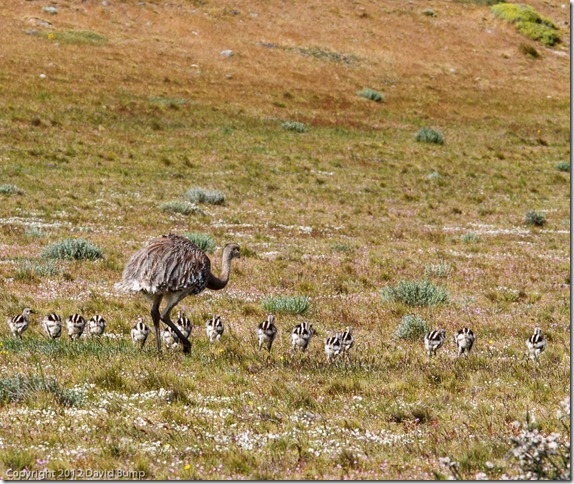
The tour we chose was a safari in the Patagonian steppe, in which you drive onto a working estancia (or ranch), which is also a natural reserve, in a 4x4 Land Rover, learn about the geology of the area, see wildlife including guanacos, nandu (a small ostrich-like bird), and Andean condors, and learn about the traditions of the gauchos, including the ritual of yerba mate. The tour also included lunch out on the steppe.
When Lana told the proprietress of our hotel what we were doing for the day, she looked at her skeptically and said there was no such thing. We think she prided herself on knowing all the tours, and this was one she wasn’t familiar with. It gave us pause, but we hope she recommends it in the future—we certainly sang the company’s praises when we returned from the trip. When our guide arrived that morning, she interrogated him briefly—we think she was concerned we were getting ripped off.
Our guide for the day was Teo, who picked us up at our hotel in the promised Land Rover. We were pleasantly surprised to discover that there was no one else booked for the tour, so we got the experience of a private tour without having to pay extra for it!
As you can see from the photos, everything was in bloom on the steppe.
After a stop to look at the geological formation of the steppe and identify, and in a couple of cases even taste, various plants we drove a bit further until we spotted a few Andean condors circling in the thermals above a valley.
While we were watching them, Teo told us that some Andean condors live for 70 years. The ones that reach this age do so because around the age of 40, they find a cave at the beginning of winter, pluck out all of their damaged feathers, and then grind their beak down on rocks, and let it regrow. The condors that are able to do this live much longer than those that can’t or don’t. After watching the birds a little longer, he went on to say he thought that people needed to do the same sort of thing; stop, re-examine, and start fresh. Ahem.
Teo also talked about the geology of the area. There are two different ash layers that contain numerous fossils. One is a Jurassic sea bed, full of fossilized marine life, and the other contains mammalian fossils. We took a hike to the marine layer. The white rock from the compressed ash is a striking contrast to the otherwise dark earth and green vegetation. It also shatters into thin, plate-like shards.
You almost couldn’t throw a rock without that rock containing a fossil. Many were composed almost entirely of fossils. The small ones—an inch or two long—were most numerous, but there were some shells as large as bowling balls too.
Amongst the fossils, we saw lots of what we thought were moss-covered rocks. Teo pointed one out, and explained that it was actually the only tree that grows in the steppe—nearly firm as a rock, but composed of the woody roots. Locally, it is known unkindly as mother-in-law pillow.
As we walked, we also saw free ranging horses, wild birds, and guanaco.
Guanaco are the wild variety of South American camel; llamas, alpacas, and vicuna are the more familiar and domesticated varieties. They are between llamas and alpacas in size, and while they are wary of humans, they are also extremely curious, and will approach you if you remain motionless for long enough. We tried to find a spot where they could see us, and approach at their own discretion, but the wind was coming from the wrong direction, along with some light rain, and they kept catching our scent and moving off before they could get curious.
We saw some vigorously and persistently chasing each other, and Teo told us those were males, fighting. One of the tactics of guanaco fighting is to bite the opposing males testicles off (Teo used the word eggs), rendering him an ineffective reproductive challenge to the alpha male’s herd of females. The fights start with heads low, angling for a good bite, and devolve into a very spirited chase, with high motivation on the part of the lead guanaco, and a very stretched neck on the chasing guanaco. Once we saw the behavior, it was obvious, and yet none of our other guides mentioned this. I don’t know if it wasn’t deemed family friendly, but we thought it informed highly on the nature of the animals.
The Patagonian steppe itself was very pretty. In some ways, it reminded us of other high dessert tundra. It was dry, cool, and breezy, but it was also unique.
We circled back around to the estancia cottage to try and get closer to some guanacos. But the wind was against us again and once they got a whiff of us there wandered oh so casually off. Because it had been raining on and off, Teo had a bit of a change of plans for us. Instead of making lunch for us out on the steppe, he opened up the estancia cottage and started a fire. While we got warmed up and the fire got going, he told us about the gaucho tradition of drinking yerba mate, and we shared a couple of cups of mate.
Mate is an herb that many Argentinians drink, and they claim that it has many antioxidant properties similar to those we learned about coca leaves in Peru and Bolivia. What is more interesting about mate is the ritual with which it’s drunk. Mate is a social drink, to be shared with friends. Everyone drinks from the same cup, generally a hollowed-out gourd which has been covered in silver or leather, which you pour mate leaves into, and then cover them with warm (but not hot) water, generally out of a thermos. The drink is sipped from a silver straw, which has a fine, perforated, bulb strainer at the bottom, so you get the liquid and none of the leaves. The first couple of cups are somewhat bitter, so the host drinks these to prepare the gourd for the next drinker he passes the cup to. The etiquette involved is that you drink the entire cupful of mate before passing it back to the host, or refilling it and passing it on to the next drinker. You only say ‘gracias’, while handing the gourd back empty, when you are finished drinking entirely, and don’t want to be included in future rounds. There are two different types of mate: suave and dolce. The suave is stronger, more bitter and unsweetened; the dolce is, well, sweeter. Since we were out on the steppe with gauchos, we only had the suave. It was very strong and bitter. We likened it to an oolong, but more weedy. We each drained the gourd, and had a scone that Teo set out for us to try and get the taste out of our mouths. It wasn’t bad, per se, but we didn’t want any more than one full—so we said ‘thank you!’
While lunch was heating up, we shared some bread and cheese and a glass of wine, all of which was very tasty, and quite welcome after our tromp around the hills in the mist.
Lunch was a beef and rice stew, with a good glass of red wine added while it was on the fire. It was delicious, and very warming.
After a dessert of stewed fruit with a little more wine and some whipped cream, Teo took us down out of the steppe and dropped us back in town. It was an unexpectedly lovely morning, and we find ourselves coming back to it as we think about all the amazing things we did in Patagonia.